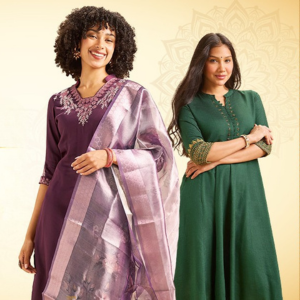

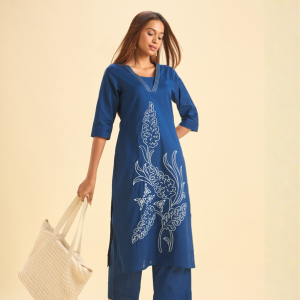
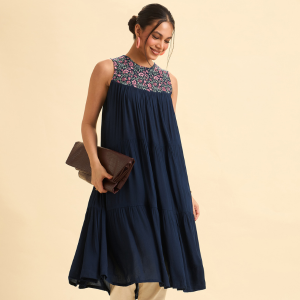
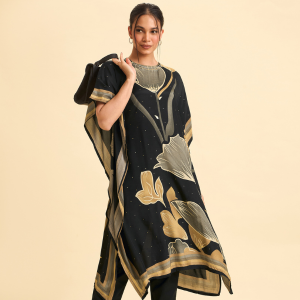


A printed co-ord set solves the most annoying part of getting dressed: deciding what goes with what. The top and bottom are cut from the same print, so the outfit is done the moment you put it on.
But a co-ord can also go wrong in ways a single kurti doesn't. A print that looks good on a model can swallow you. A fabric that feels soft in the store can cling by noon. And a size that fits on top can be loose at the waist, because you're buying two garments in one size.
This guide covers what to check, in the order that matters: fabric first, then print, then fit.
What counts as a printed co-ord set?
A co-ord set is a top and bottom designed to be worn together, usually in the same fabric. In a printed co-ord, the print carries across both pieces. Sometimes it's the same all-over print, top to bottom. Sometimes the top is printed and the bottom picks up one colour from it, or has a printed border that echoes the top.
Ethnic co-ord sets are close to kurti sets, and the line between them is blurry. The usual difference is length and cut: a co-ord top tends to be shorter, often hip-length or a shirt-style tunic, and the set rarely comes with a dupatta. That makes co-ords easier to wear to work, on a trip or out for the day, where a dupatta just gets in the way.
Start with the fabric
The fabric decides how the set feels after six hours, how the print looks after ten washes, and whether you'll actually reach for it. Check the composition on the product page before you look at anything else.
|
Fabric |
How it feels |
Best for |
Watch out for |
|
Pure cotton |
Crisp, breathable |
Daily wear, hot days |
Creases easily; can shrink slightly on first wash |
|
Cotton flax |
Textured, slightly stiff, airy |
Office, travel |
Feels stiff at first; softens after a few washes |
|
Viscose / rayon |
Soft, drapes well, cool to touch |
Relaxed cuts, palazzo sets |
Can cling in humidity; needs a gentle wash |
|
Modal satin |
Smooth, fluid with a subtle sheen |
Evenings, small functions |
Shows water marks; hand wash or delicate cycle |
|
Crepe |
Fluid, doesn't crush |
Travel, long days |
Can feel warm in peak summer |
|
Chanderi |
Light, slightly sheer |
Festive and dressier occasions |
Light colours may need an inner or lining. Gentle Care - Hand Wash Only |
A simple rule: if you'll wear it for a full workday or in the heat, pick cotton or cotton flax. If you want the set to look dressier and drape more, go for viscose, modal or chanderi.
Then look closely at the print
The print is why you're buying it, and it's also where most mistakes happen. Three things to look at:
Print size. Large motifs make a strong statement but visually add width, and on a petite frame they can look like the print is wearing you. Small, dense prints such as ditsy florals, small buttis and fine geometrics are easier to wear and suit almost everyone. If you're unsure, go one size smaller in print than you think.
All-over or placement. An all-over print covers the whole garment evenly. A placement print sits in one area, such as a printed yoke, a border at the hem or a panel down the front. Placement prints draw the eye to wherever the print is, so use that: a printed yoke frames the face, a hem border adds weight at the bottom.
Base colour. Look at the background, not just the motifs. A print on ivory or pastel reads light and daytime. The same print on black, navy or maroon looks more finished and works into the evening. Dark bases also hide small stains better, which matters for a set you'll wear often.
For matching the print to the occasion: bold florals and bright multicolour for weekends and travel, small geometrics or abstract prints in two or three colours for the office, and block or hand-block style prints for festive days at home.
Get the cut right
A co-ord is two garments, and each one has to work on its own. Look at the top and the bottom separately.
The top
• Hip-length kurta or tunic. The most versatile length. It covers the waistband and works with straight pants or palazzos.
• Shirt-style top. Collar and button placket, often in cotton or cotton flax. Looks sharp for work and can be worn open over a camisole.
• Short or boxy top. Better with high-waisted, wide bottoms. Less forgiving if you'd rather not define the waist.
The bottom
• Straight pants. Neat and office-friendly. Easiest to re-wear with other tops.
• Palazzos. Comfortable and cool, and they balance a fitted top. In a big print, they make the whole outfit read loud, so a plain or border-only palazzo can be the safer choice.
• Flared or culotte pants. Good movement, slightly more casual.
Check the waistband too. A full elastic waist is the most forgiving if your top and bottom sizes differ. A drawstring or half-elastic waist looks neater but fits a narrower range.
If you're between sizes or have different top and bottom measurements, choose your size based on the top. Elasticated waistbands offer more flexibility in fit than kurtas.
Before you add it to cart
Buying a co-ord online means you can't feel the fabric or try it on. These checks take two minutes and save a return:
1. Read the full fabric composition. "Cotton blend" can mean anything. Look for a percentage or a named fabric.
2. Use the garment measurements, not just S/M/L. Compare the chest, waist and length to a set you already own and like.
3. Check the top length in inches. Model photos are misleading. 36 to 40 inches is roughly knee length on most women; under 30 is hip-length.
4. Look for an inner or lining on light-coloured or chanderi sets. If there isn't one, plan for a camisole.
5. Zoom into the print. Check whether it's crisp or slightly blurred at the edges, and whether the pattern lines up at the side seams.
6. Check for pockets. A small thing you'll be glad of every time you wear it.
7. Read the return and exchange policy, especially on sale items.
If you're near a store, trying a co-ord on once tells you more about your size in that brand than any size chart.
One set, several outfits
The best co-ords earn their price by being worn apart as well as together. Before buying, picture each piece with something you already own:
• The printed top with plain bottoms. White, black or beige pants or jeans calm the print down for work or a casual day.
• The printed bottom with a solid top. Pick a kurti or shirt in one of the colours from the print.
• The top worn open as a layer. Shirt-style co-ord tops work as a light jacket over a solid kurti or a tee.
• The full set with a dupatta or stole for a family function, which turns a casual co-ord into something more dressed up.
If you can't think of at least two other ways to wear it, the set will probably stay a once-a-month outfit.
Keep the print looking new
Prints fade from heat, sunlight and harsh detergent. A few habits make a big difference:
• Wash the first time on its own in cold water. Some dye release is normal in the first wash.
• Turn it inside out before washing and drying, so the printed side doesn't rub.
• Use a mild liquid detergent. Skip bleach and strong powders.
• Dry in the shade. Direct sun fades bright prints fastest.
• Wash both pieces together, every time. If you wash the top more often, it will fade faster and stop matching the bottom.
• Iron on the reverse, on the setting for the fabric. Viscose and modal need low heat. Always follow the care label first. These are general habits, not a replacement for it.
Find your printed co-ord set at Vismay
The short version: choose the fabric for how you'll wear it, the print size for your frame, and a cut you can split into separates. Then check the measurements before you buy.
Vismay's co-ord sets come in cotton, cotton flax, viscose and more, in sizes XS to 3XL, with new prints added every week. Browse online, or try a few on at your nearest Vismay store.
FAQs
What is a printed co-ord set?
A matching top and bottom made in the same printed fabric, designed to be worn together as one outfit. In ethnic wear, it's usually a kurta or tunic with pants or palazzos, without a dupatta.
Which fabric is best for a printed co-ord set?
Cotton or cotton flax for daily wear and hot weather, since both breathe well. Viscose, modal or chanderi if you want a softer drape or a dressier look.
Are printed co-ord sets suitable for office wear?
Yes. Pick a small print or a geometric pattern in two or three colours, a straight pant and a hip-length top. Shirt-style co-ords in cotton flax are especially easy to wear to work.
Can short women wear printed co-ord sets?
Yes. Choose small or medium prints, a hip-length top and straight or slightly flared pants. Very large motifs and long, wide palazzos can overwhelm a petite frame.
What is the difference between a co-ord set and a kurti set?
A kurti set usually has a longer kurta and often a dupatta. A co-ord set tends to have a shorter top, no dupatta and a more contemporary cut.
How do I stop a printed co-ord from fading?
Wash it inside out in cold water with mild detergent, dry it in the shade, and always wash both pieces together so they fade at the same rate.